

Nothing About You Is Fixed
What changes when we begin to see ourselves as something unfolding, rather than something set.

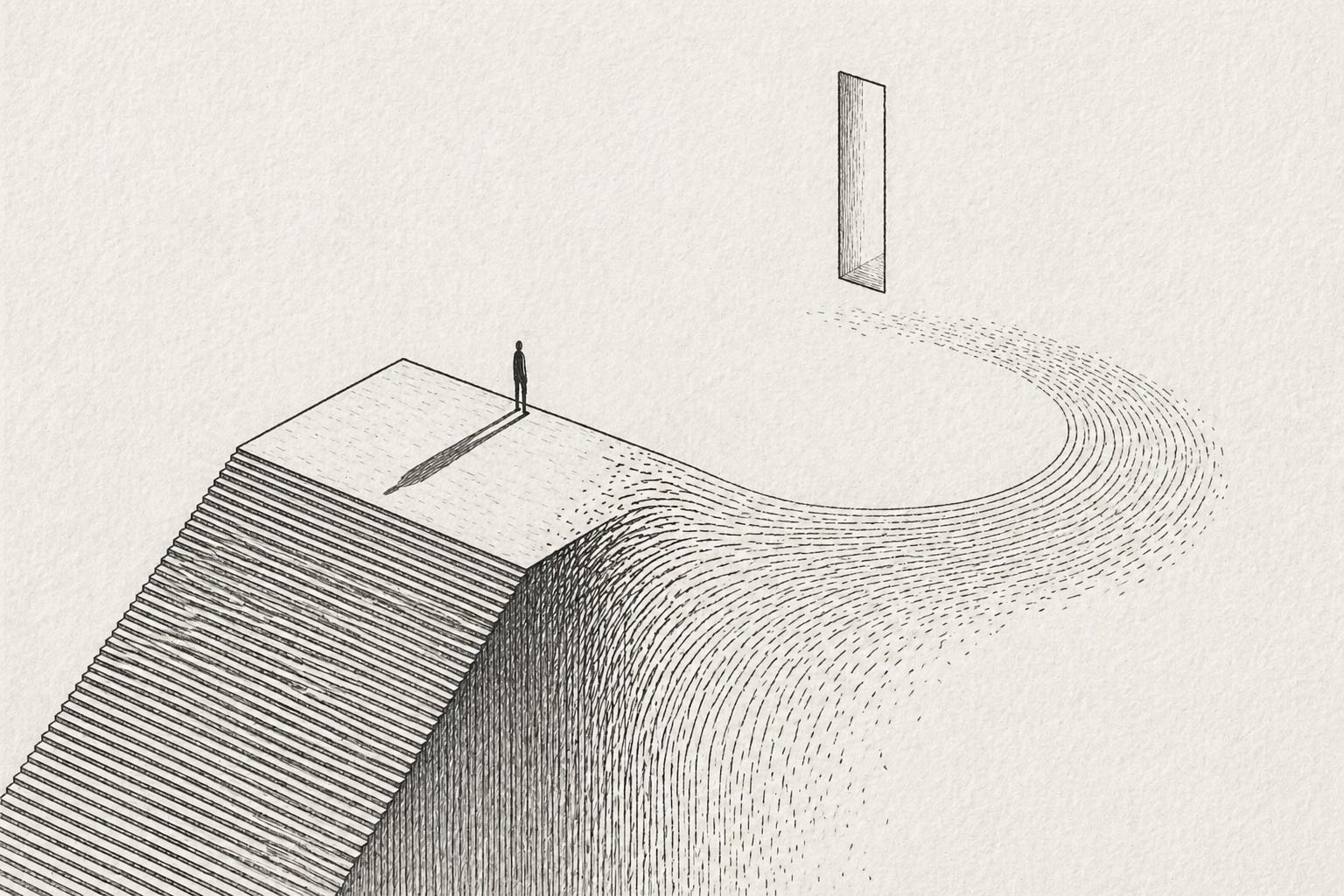
The Point Where It Starts to Feel Settled
There’s a moment most of us reach at some point, and it rarely arrives with any kind of announcement. It tends to build through repetition, through familiarity, through the slow accumulation of experiences that begin to look the same. You notice a pattern in how you respond, how you feel in certain situations, how you tend to move through parts of your life, and after a while it starts to feel less like something that is happening and more like something that is simply true about you.
It might show up in small ways. You find yourself saying you’re not great in social situations, or that you tend to overthink, or that you always seem to end up in the same kind of dynamic with people. Nothing dramatic, just observations that feel accurate enough to repeat. Each time you say them, they carry a little more certainty. Each time they are confirmed by experience, they feel a little more settled. Over time, the pattern begins to look like a conclusion rather than something still unfolding.
That’s the point where something changes in how the pattern is held. The explanation starts to become the thing itself.
When Patterns Start Looking Like Identity
There’s nothing wrong with noticing patterns. In fact, it would be difficult to function without them. Patterns allow us to recognise what is familiar, anticipate what might happen next, and organise experience into something that makes sense. Without them, everything would feel disconnected and difficult to navigate.
What matters is the way those patterns are interpreted. What begins as “this tends to happen” can gradually become “this is what I am like.” That change is small in language, yet significant in its effect. The first describes a tendency that appears under certain conditions. The second suggests a stable identity that exists regardless of context.
You can feel the difference if you stay with it for a moment. Saying “I tend to feel anxious in situations like this” keeps attention connected to the situation. It leaves space for variation, for context, for the possibility that something else may also be present. Saying “I am an anxious person” removes that context. It places the experience into a category that appears consistent across time and situation.
Once something is placed into that category, it begins to feel resolved. There is less reason to look closely, because the answer appears to already be there.
The Problem With Something That Feels True
The difficulty here is not that these descriptions are inaccurate. Most of the time, they are grounded in real experience. If something has shown up repeatedly, it makes sense to recognise that. There is a form of honesty in acknowledging patterns that have been difficult, persistent, or hard to understand.
The issue is that what feels true is often treated as though it must therefore be fixed. That step happens quickly, and it usually goes unnoticed. A pattern that has been observed becomes a statement about identity, and that statement begins to shape how future experience is interpreted.
There is a difference between something that happens often and something that cannot be otherwise. That difference matters, because it determines how open or closed the future feels. If something is seen as happening often, there is still the possibility that it may not happen in the same way next time. If it is seen as fixed, that possibility disappears before the situation has even unfolded.
When the past is carried forward in this way, it begins to shape the present before the present has had a chance to show itself.
What We Stop Noticing
Once a pattern is treated as fixed, attention begins to organise itself around that conclusion. Experiences that align with the pattern stand out clearly. They feel familiar, expected, and confirming. Experiences that do not align with it tend to carry less weight. They may still occur, yet they are often overlooked, dismissed, or explained in a way that keeps the pattern intact.
This is not a conscious process. It is simply how perception works when a conclusion has been reached. The mind prioritises what appears relevant, and once something feels settled, there is less reason to question it. Over time, this creates a very convincing sense of consistency.
The result is that variation becomes harder to see. The experience may still be changing in small ways, yet those changes are not given the same attention. The pattern appears stable, not because it is unchanging, but because what is noticed has already been filtered through what is expected.
This is one of the reasons the sense of being fixed can feel so real. It appears to be supported by experience, when in fact the experience has already been organised around that belief.
Looking Without Deciding Too Quickly
A different way of approaching this begins by slowing down the movement from experience to conclusion. Instead of immediately translating what is happening into something familiar, there is a brief moment where attention stays with the experience itself.
This does not require a particular technique or a special mindset. It is simply a matter of noticing what is present before it is explained. What is being felt, where it is felt, how it changes as attention moves, what thoughts are appearing and how they develop over time. The aim is not to analyse or fix anything. It is to see what is there in more detail.
When attention is held in this way, the experience often becomes more complex and less easily defined. What seemed like a single, stable state begins to show variation. There may be different elements within it, each with its own quality, intensity, and duration. These elements interact, shift, and respond to what is happening in the environment.
That movement is always present, even when it is subtle. It tends to be missed when the experience is quickly reduced to a single word or idea.
Nothing About You Is Fixed
Seen in this way, the idea that nothing about you is fixed begins to move away from being a statement to believe and becomes something that can be observed. It is not a claim that everything is easily changeable, or that patterns lose their influence. It is a recognition that what is experienced is always happening in the present, shaped by conditions that are themselves changing.
Even the most familiar patterns are still processes. They unfold in response to context, to attention, to history, and to what is currently taking place. They may feel consistent, yet they are not static. They are maintained through repetition, and repetition depends on conditions.
When those conditions change, even slightly, the pattern has the potential to appear differently. That difference may be small, and it may not always be noticed. Yet it is there.
Recognising this does not remove difficulty, although it does alter the sense of being confined by it. It introduces the possibility that what is happening now is not the only way it can happen, even if that possibility is not immediately clear.
A Different Relationship to Yourself
What tends to change first is not the pattern itself, but the way it is held. Instead of being treated as a defining feature, it begins to look more like something that arises under certain conditions. This changes the relationship to it, because it is no longer seen as a permanent part of identity.
It becomes easier to notice when the pattern is present, and also when it is less present or absent altogether. These moments may be brief or subtle, yet they carry information that would otherwise be missed. They show that the pattern is not constant, even if it appears that way when viewed from a distance.
This creates a different kind of space. Not one that demands change or improvement, but one that allows for a fuller view of what is happening. Within that view, there is more variation, more movement, and more possibility than the original description suggested.
Not a Conclusion, Just Another Way of Seeing
This is not an attempt to replace one fixed idea with another. It does not require rejecting what has been learned through experience, and it does not deny the impact of patterns that have been difficult or persistent. It is simply an invitation to look again, without settling too quickly on what those patterns mean.
Another way of seeing it.
One that stays closer to what is actually happening, rather than moving straight to what it must represent.
If you stay with that long enough, you may begin to notice something that has always been there.
Not a dramatic change, and not a sudden transformation.
A different sense of what is possible, grounded in the recognition that what you are is not something that has already been decided.